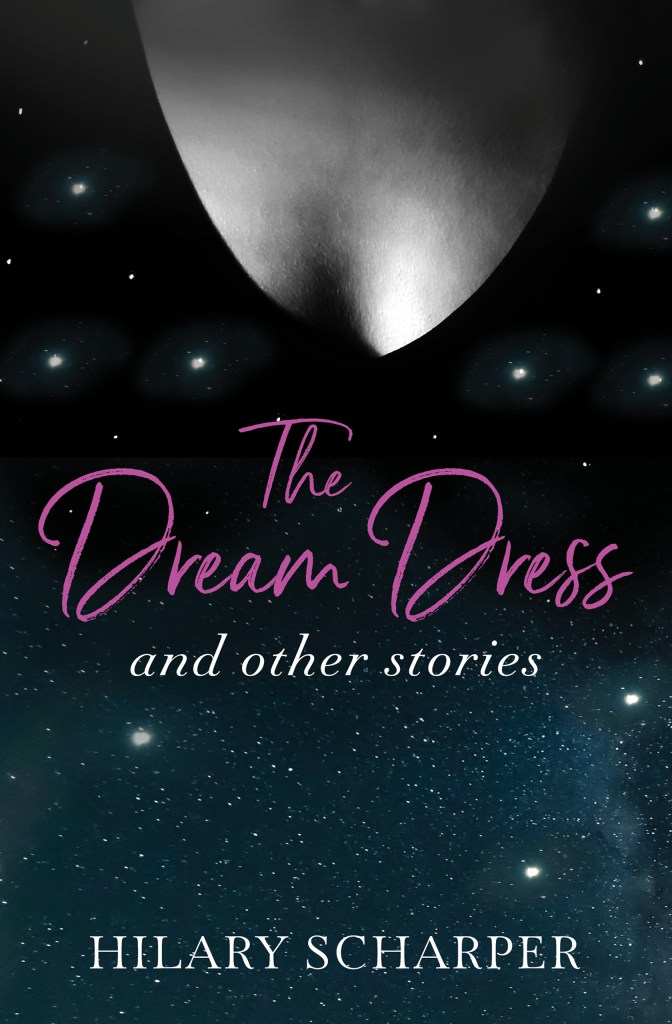
Childhood 1961-1978
My parents were Catholic and had four children in rapid succession: 2 boys, 2 girls. They were not “happy campers” as a couple and “the kids” were often the target of their frustration and, unfortunately, at times, rage. I was the second and eldest daughter. I had a lot of responsibility … and eventually a lot of conflict with my parents. Clothing was not exempted.
My mother was, in a word, cheap. My father, on the other hand, inclined toward the extravagant and was forever foiling the household budget. As a result my mother was always “borrowing” money from her parents as she tried to make the books balance—a Sisyphean task in light of my father’s profligacy.
Perhaps guilt about taking money from her parents contributed to my mother’s frugality, but when it came to clothing, she always—and I mean to the end of time—bought us kids things that were seriously marked-down or to be found in a bargain basement.
Often too small, or usually several sizes too big—I grew up in clothing that never quite “fit.”
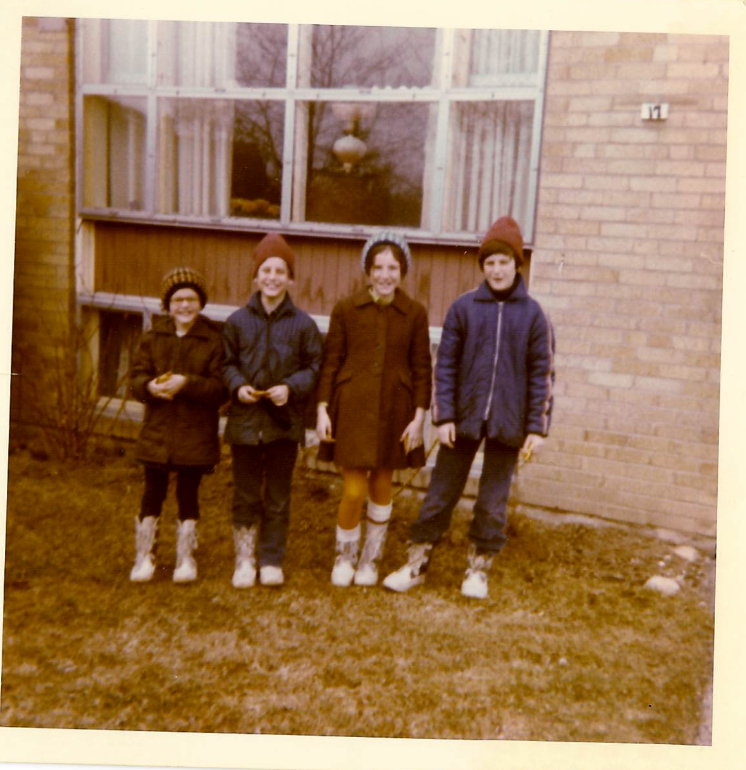
When I look back at this snap shot of us 4 kids above, the word “ragamuffin” comes to mind. I am second from right…in a coat way too small for me and boots way too big. (Sigh.)
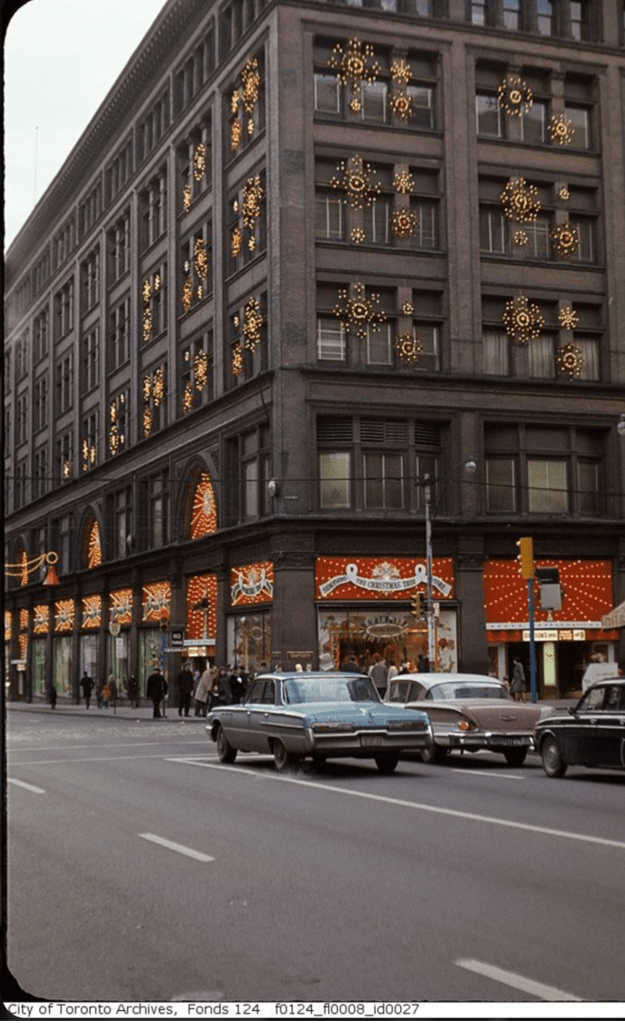
When I was about twelve, my father was given the job of getting us four kids running shoes. Much to our delight he took us to a “real” shoe department in Simpsons, a store beloved to us for its enchanting Christmas windows. We went up to the second floor (not the usual down to the basement) and we were actually fitted by a real salesperson!
It was like visiting another planet.
We all came home with the then very popular North Star Four Star running shoes. It seemed like a miracle! But, oh my … there was hell to pay from my mother because he had paid the regular price for our shoes. Needless to say, my father was never again to be put in charge of buying us footwear (or any kind of clothing for that matter), but that year was magical for me—shoes that fit and even more glorious, shoes that were stylish and not unlike what the other kids were wearing.
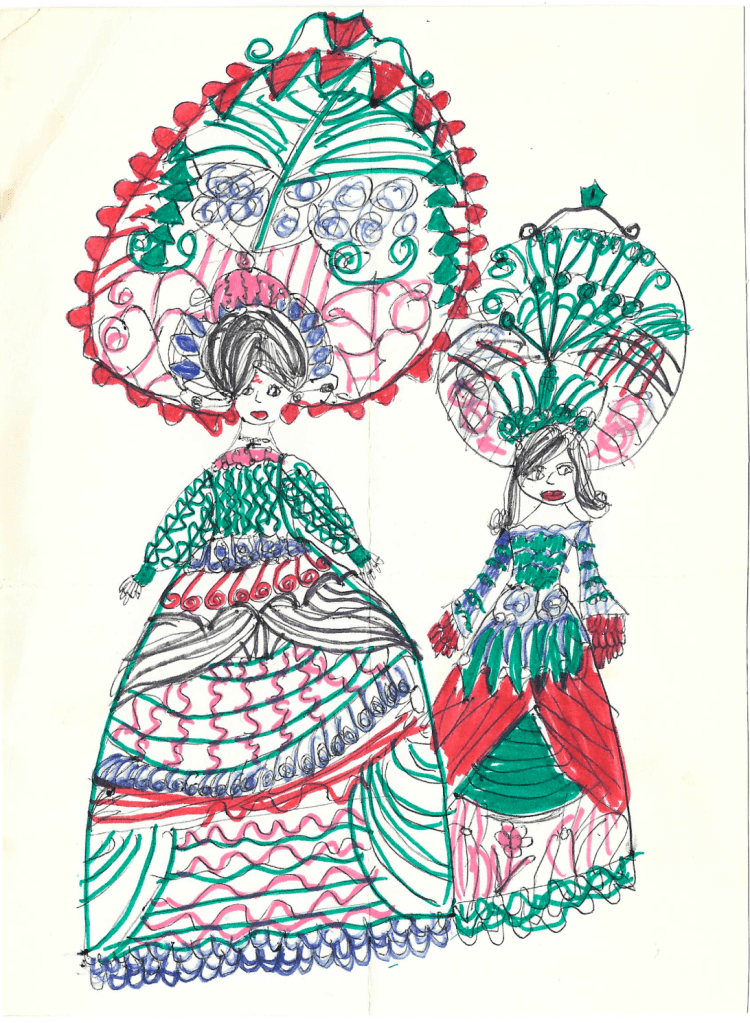
As I grew older, I often felt humiliated and embarrassed about my clothes. I yearned for clothes that not only fit me, but which expressed my own sense of fashion. This was not easy. One thing I did—from about the time I was five—was fantasize about clothing by drawing pictures of what I considered to be beautiful ladies in beautiful dresses. These were always images of women in enormous gowns with massive headpieces.
I drew hundreds of these beautiful-ladies, as I called them, and yet have only one in my possession. It was sent to me by my Aunt Margaret when I was in my twenties. Years before, I had given it to her as a card thanking her for a stay-over at her house during which my cousin Suzanne and I had our hair done up in curlers and played dress-up …
As I look back on these dresses, they also strike me as “fortress dresses,” almost like protective gown-gear for a small child growing up in a hostile environment. (Note the helmet-like head gear!)
The Story The Colour of Gray speaks very much to this period in my life and is based on a true experience.
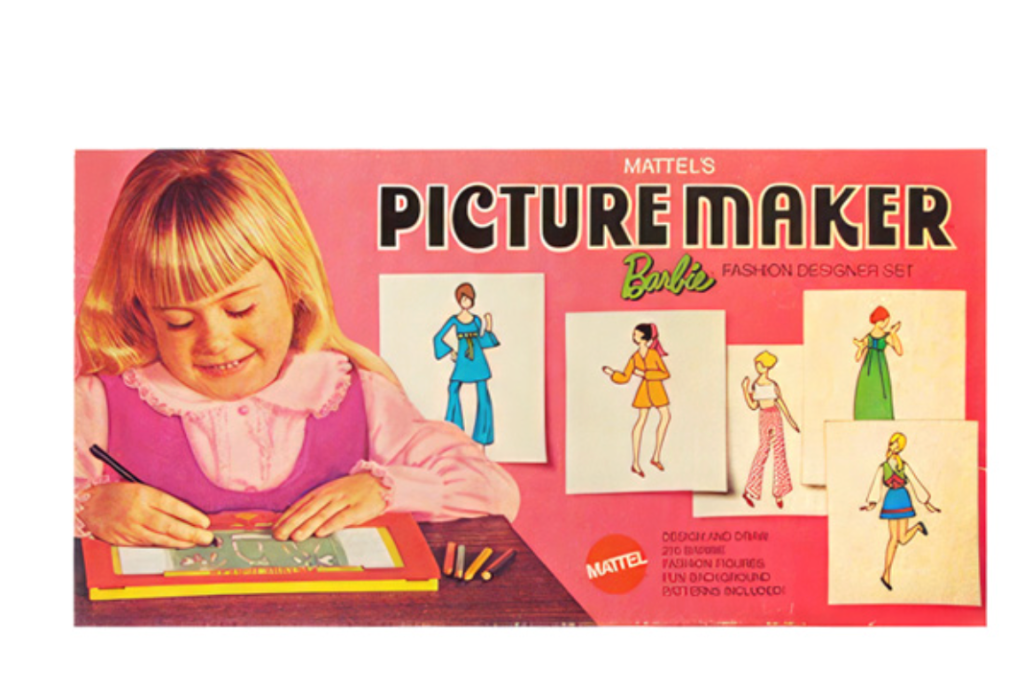
When I was nine my grandmother gave me a “Mattel Picture Maker Fashion Designer Set” for my birthday—a popular toy which allowed kids to “become fashion designers.”
The toy had a drawing board and several stencils with patterns for hair/hats, tops, and bottoms.
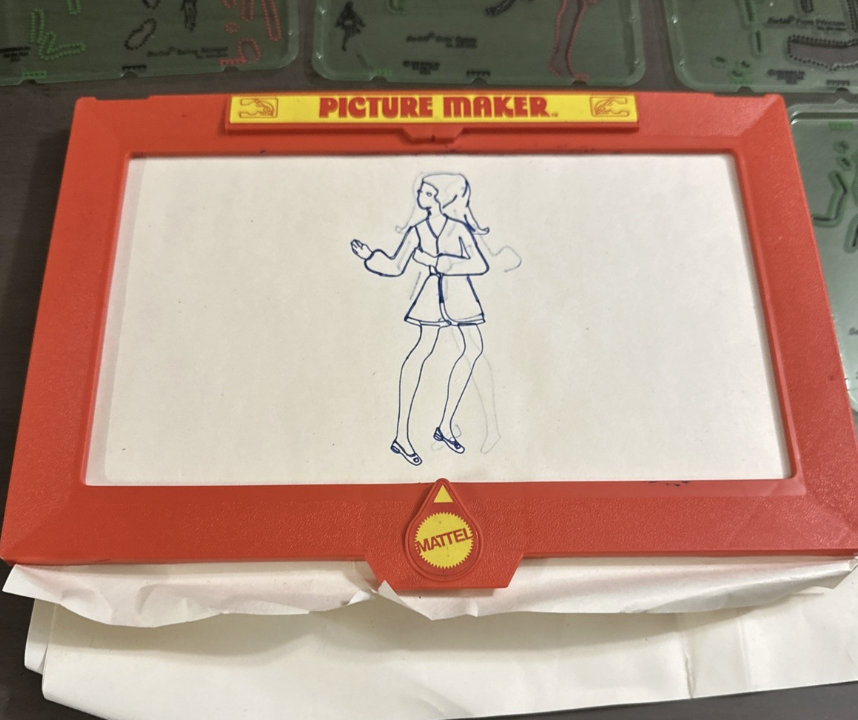
The idea was to trace the cut-out parts in the stencil (following a simple sequence)—and, voila, there was your design, a line drawing of a model in an outfit, looking pretty professional and waiting to be coloured-in.
In the tradition of my beautiful-ladies, I filled in the drawings with complex patterns and colours. I absolutely loved this toy. Unfortunately, my mother—who was a high-school art teacher—felt that this was not “true drawing” and, more to the point, that fashion design was not “true art.” She was very critical of my using the toy and at one point became quite severe, even mocking. This left me crushed and ashamed—so I played with the toy in secret, nevertheless absorbing the idea that anything that had to do with fashion or fashion design was somehow frivolous and not suitable for a “real artist.”
As a final thought from my childhood years, I think my journey toward writing Dream Dresses was also very much influenced by my experiences of our family cottage on Georgian Bay (also funded by my grandparents). This became a place truly close to my heart and indeed, to this day, I think of myself as being raised by the Bay. From a very young age, I would go for long walks by myself, mesmerized by the movement of the waves, finding the shoreline a very peaceful place. At that time, I would watch the waves and their frothing crests, as well as the delicate lines they always left in the sand—and I imagined the waves as frills of lace and the wavy lines as the edges of a petticoat peeping out below the hem of a giant, wondrous dress.
I believe that it was at this time that I developed the idea of Nature as fabric: as some sort of body (female in my mind) clothed in an enormous, ever-changing, living dress. From sunsets to stars in the night-sky, to roaring waves, to a forest of trees stirring in the wind—Nature, in both sound and sight—swishing, whispering, fluttering, magnificently silent, glimmering, gleaming—taken all together—a marvelous dress.
My husband Stephen later described this as “bio-fabricphilia”—tying into the ways in which we not only talk about the world around us in fabric-like terms (e.g., “weaving a web of lies,” “cut from the same cloth,” “dyed in the wool,” “close-knit families,” etc.), but also the sense that life itself is an evolving “tapestry” and that fabric is much more than a mere piece of object-like material.
The stories The Dream Dress and Little Black Dress, in particular, build upon this experience of Georgian Bay and these notions of fabric as sentient in some way.
Marriage, Education and Academia: 1979—
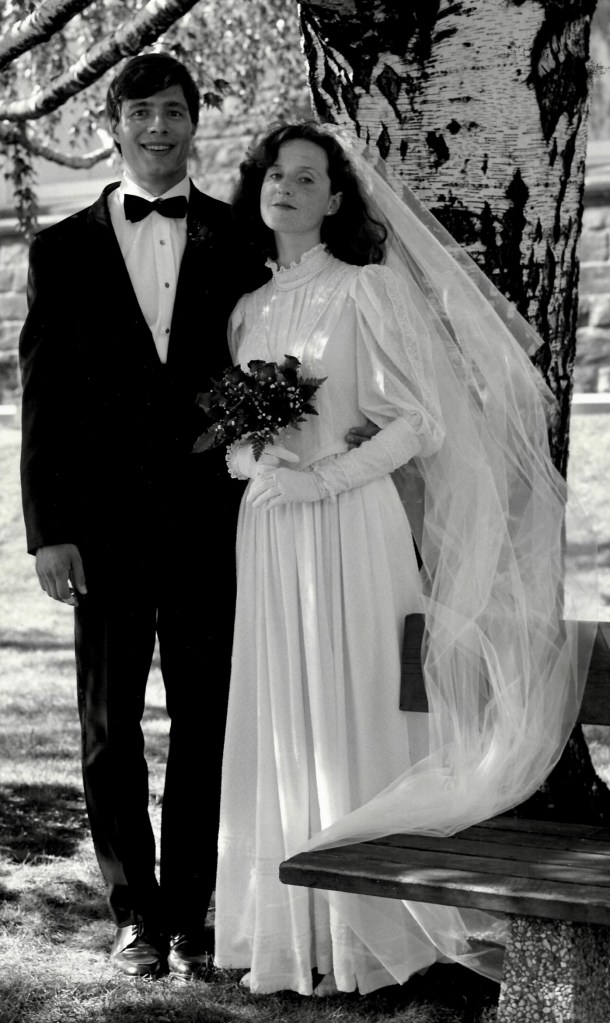
After leaving home at 18, I managed to attend the University of Toronto, where I met my husband Stephen. We married in 1984 and I continued my education, eventually receiving a doctorate in cultural anthropology from Yale University at the age of 31. These were interesting years as I much more freely navigated self-expression vis-a-vis clothing.
During my twenties, vintage was in full force, and so it was fun exploring my own fashion sense through retro stores, albeit usually on a very slender budget. My husband was a diehard thrift-store shopper at the time, and is, to this day, very proud of the fact that he paid $20 for the tuxedo he wore for our wedding (From Courage My Love in Kensington Market, Toronto—to this day, still selling the vintage vibe.)
I think it was during this period that I truly fell in love with fabric. I did not know how to sew, yet I loved fabric. Yale was based in New Haven, CT and the downtown had a family-owned fabric store (Horowitz Brothers) located on 760 Chapel Steet. The brothers had started out with a fabric pushcart in the early 1900s and, as their business flourished, eventually opened a storefront in 1939. I spent more time in that store than I should admit.
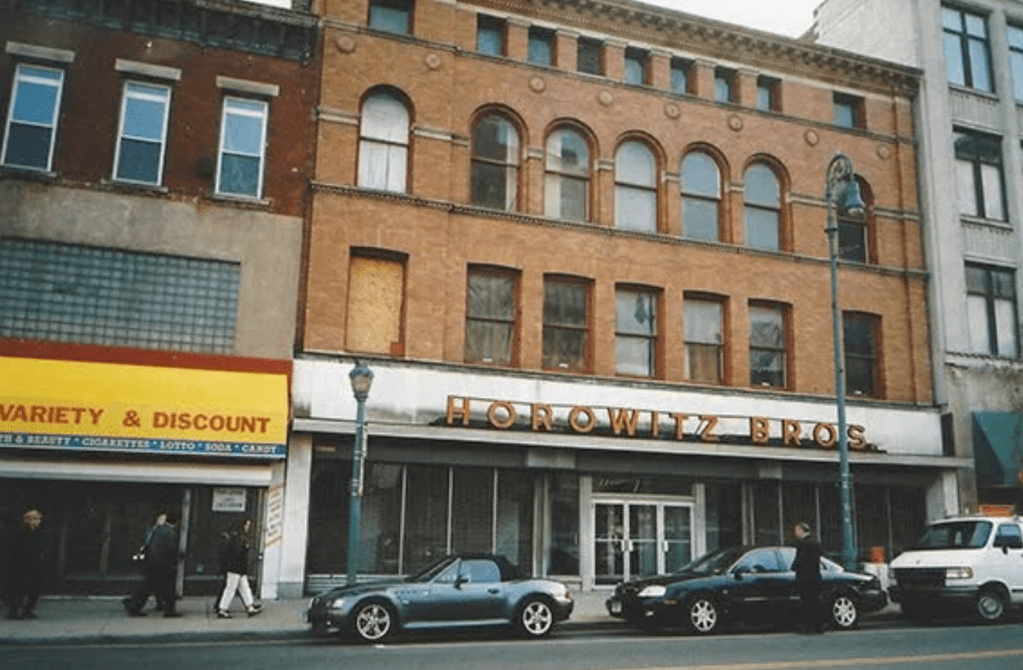
In the late 1980s, however, New Haven’s downtown was really struggling. A downtown Macy’s department store had held on, and so Horowitz Brothers held on, too. As a break from school, I would rummage around in the store, finding interesting, odd-sized “remnants” of cloth, many of them dating back to the 1940s and 1950s.
If I had any extra money, I would buy a remnant, taking it home with me and storing it away, pondering how it might become part of my future (a dress, a tablecloth, curtains, upholstery?). But mostly I bought the cloth because I thought it beautiful and couldn’t bear to think of it as languishing in the dark recesses of a shelf.
To this day, I still have a couple remnants from Horowitz Brothers, and I also used a particular bolt of lace for an installation I did on Georgian Bay.
All this fabric-hunting was “on the sly,” as the saying goes, because I was a serious student, focusing on serious topics, right? I definitely got the impression from my professors and many fellow students that shopping for clothing, rummaging through a sale dress-rack, or flipping through fashion magazines was superficial. Certainly not appropriate for a social scientist—unless of course I packaged it in some sort of acceptable anthropological framework, such as:
• Dress as a powerful social tool, negotiating social status and defining gender roles …
• Dress as an expression of identity …
• Dress and the politics of production (i.e., the underside of the garment industry) …
All excellent topics.
And all of these things are woven into my stories … and yet … there was something missing. Something about the fabric, the dress, the clothing itself … something about how it, like other artifacts, perhaps had stories to tell. Maybe not the grand stories of important people, but quieter ones. Everyday stories. Important stories in their own right … about life … about being a woman … about foolish choices … about vulnerabilities … about successes and failures. In other words, a hidden world of dressing in which “the thrill of victory … and the agony of defeat” also had its place.
To a “serious” academic, however, the very idea sounded fanciful … more suited to a literary sensibility … and fiction.
So to fiction I went.
Enter the Literary: 2000—
As a cultural anthropologist I was trained in ethnography—a method which involves an attentive hanging-out with a network of people, trying to understand their perspectives and experiences (usually involving recorded interviews as well).
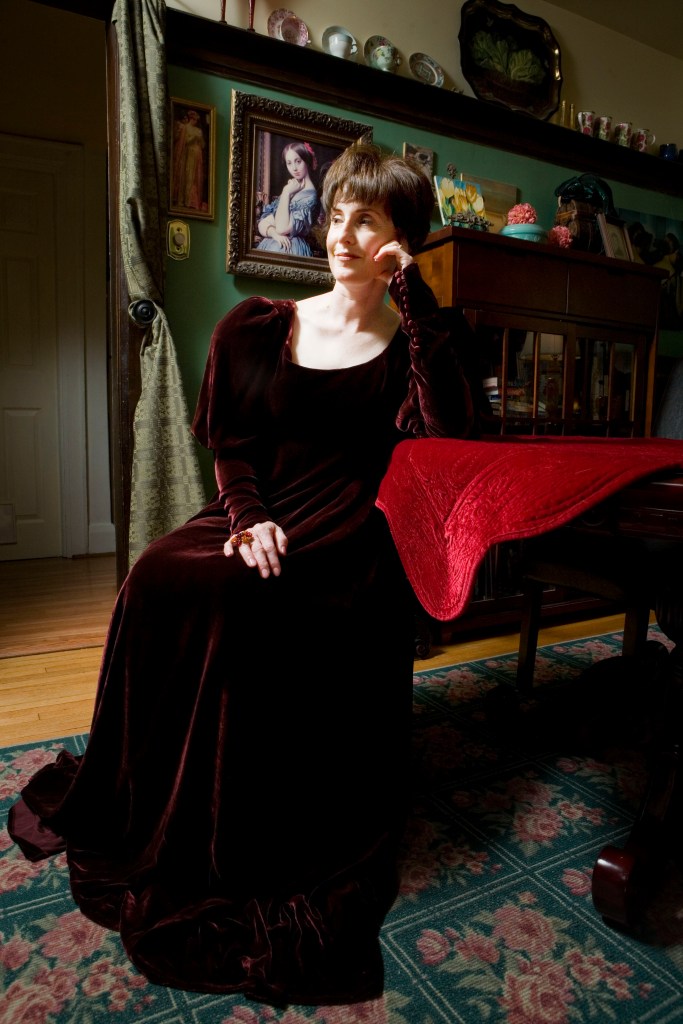
I got my first real teaching job at the University of Notre Dame in 1994, with its then “notorious” anthropology department. (I am happy to report that it is no longer notorious, quite the opposite in fact.)
Although I had an 8-month-old son and was still breastfeeding, the Chair gave me all the earliest morning classes, and all the big, labour-intensive, introductory courses that senior faculty didn’t want to teach.
It was rough—both physically and emotionally—but it was at this time that I purchased a dress, on a lark and with no concrete plan to wear it. This dress later became the “dream dress” I wore to the book launch of my short story collection at Massey College, Toronto.
As an anthropology professor, I often included a segment on “dress” in my courses and discovered that it was a very rich topic for my students. Some conducted mini-ethnographies on “fashion-on-campus”—yielding fascinating insights about the choices students and professors make about what they wear. This, in combination with research of my own, led me into a deeper relationship with fabric and dressing, particularly as I learned how often dresses and dressing are connected to the interior lives of women. These inner spaces and places, filled with dreams and desire, doubts and vulnerabilities—when they surfaced in our conversations—it was almost like going into a “secret closet” of that person’s life. It was a very different way of talking about dress … one which I found both compelling and fascinating. What was in my own “secret closet”?
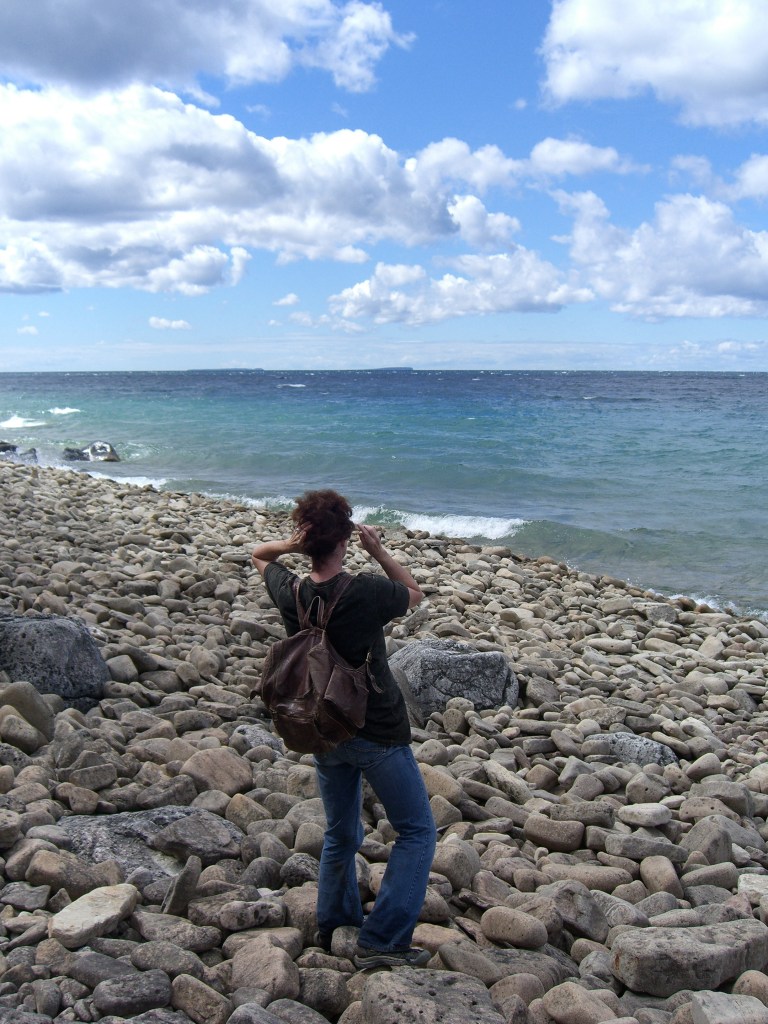
One of the first things I did in order to explore this question was to find a space where I could creatively express some of the thoughts and feelings I was experiencing—but without the constraint of the university looking over my shoulder. I decided to stage a couple of “installations” in a wilderness area on Georgian Bay. No one came to these installations except me. I suppose it was “me” meeting an aspect of myself. The location was on the Saugeen-Bruce Peninsula in a remote nature preserve, in a pine barrens, not far from the Cabot Head Lighthouse. (This area later became the setting for my two novels.)
The first installation involved a very large bolt of white lace that I had purchased from Horowitz Brothers several years before. The lace was polyester, circa 1960: bubbled, doggedly wrinkle-resistant, and full-bodied. I had about 12 yards of it and staged a “bride” in an abandoned Heron rookery, twisting the lace around several dead, standing trees, using the wind as “dresser.” It was an extraordinary experience and rather liberating. My hands and imagination were free to wander, unmoored from an analytical framework … present to the mystery of the fabric, and the haunting sounds of the snags creaking as the lace moved … and present to the mischievous curiosity of the wind, co-conspirator and creator.

It was at this time that I began writing the short story collection titled Dream Dresses, well-aware that such a topic might not go over well in my department and might, indeed, hinder my academic career. I began by writing a poem directed at both myself as an author and the reader. It began:
Did you ever dream of a dress?

The second “installation” was bolder and riskier, namely because for me to describe it sounded agonizingly silly. Take a long, black velvet dress—19th century style—hang it in a Jack pine and film the garment twisting in the wind.
Huh?
In my mind (and this was a few years before the REDress Project), what in part animated the garment’s movements were stories from the old-growth forest, especially memories of the area’s devastating logging, tales carried by the wind—uneasy, inarticulate, still suffering. (It was through this installation that my husband Stephen coined the term “ecogothic.”)
I later created a short video (very amateurish to be sure) in which I set the dream-dress poem to clips from the black velvet dress video.
(Note: the video originally used Saint Saens’s music “Aquarium” from Carnival of the Animals, but Google eventually removed the soundtrack.)
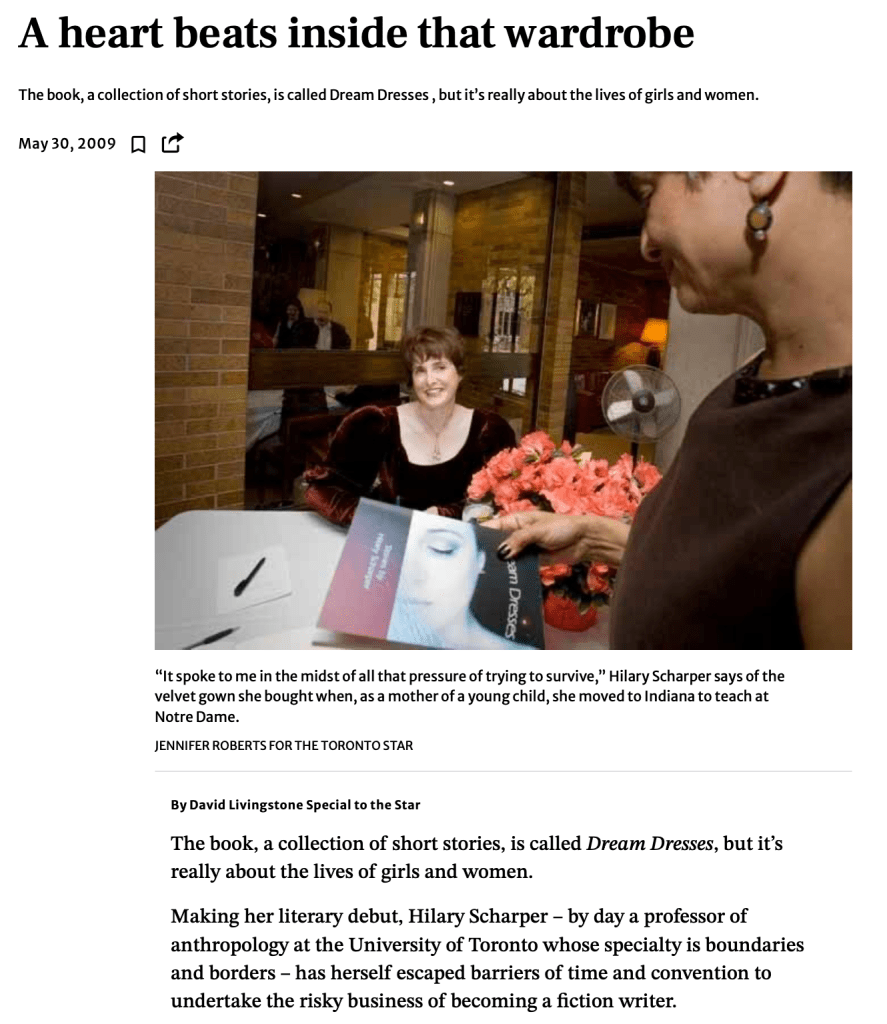
Publishing a short story collection about “dream dresses” (2009) did not go over terribly well among my colleagues at the University of Toronto. Most were polite, some even kind, but the overall vibe was disapproving.
I remember one woman, in particular, saying to me at the book launch, “My, you’re brave.”
The Toronto Star, May 30, 2009.
Indeed I’d decided to indulge myself at the book launch. I wore the long, rust-coloured, velvet dress I’d purchased during my time at the University of Notre Dame.
With mutton sleeves and a long draping skirt, no doubt I looked very Victorian-ish—something that seemed to bewilder (embarrass?) my feminist co-workers. What was Hilary doing? It was fine to choose a woman’s topic—but “the dream dress”? How ridiculous was that?
But it wasn’t ridiculous at all.
The dream dress…
Off the academic runway. Certainly marginalized in scholarly circles. Yet I knew—even as a cultural anthropologist I knew—”the dream dress” was a worthy topic.
A topic which touched upon secret worlds—worlds of desire and disappointment, courage and fear, grief and joy. Stories that were worth telling. Stories that were worth writing.
Diving into Writing 2013—
In 2013 I was still a professor at the University of Toronto, publishing academic articles, etc. But at the same time, I also published my first novel with Simon & Schuster. I was asked to make a promotional short video for my book answering the question: “If the library were burning, which book would you save?” At first I didn’t know what to say … there were so many choices! … but I ended up playing around with my love of the “classics” … and of course, dress. It was all very silly … but fun … and strangely freeing to play “dress-up” with what was in my closet.
Alas… during the Perdita book launch, a colleague approached me with a grave expression on his face, took my hand and shook it mournfully—as if we were meeting at a funeral.
But whose funeral was it?
Much to my surprise it was mine. “We’ve lost you to fiction,” he murmured woefully.
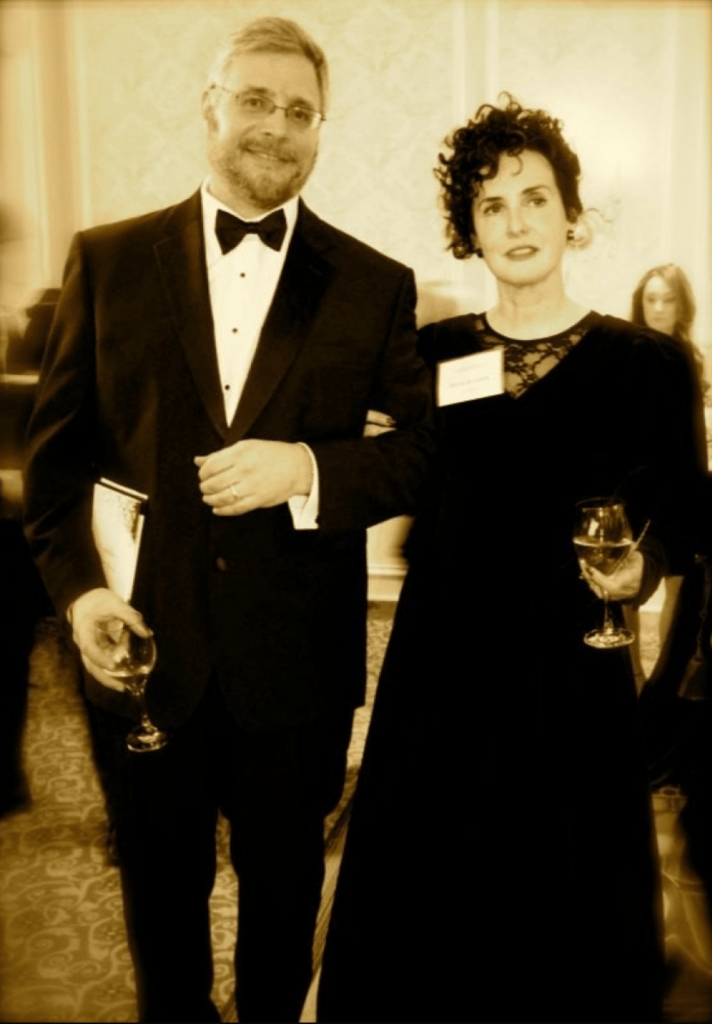
I went to the Book Lovers Ball anyway—Stephen again in a tuxedo (not the $20 one) and me in the black velvet gown from the Jack pine installation. I even had the audacity to send a photo of the event to our departmental Anthropology Newsletter. Much to my delight, the editor (a graduate student) published it.
But I was going to have to make a choice—because I was exhausted. Writing fiction at night. Teaching, writing up research, supervising graduate students during the day. (Not to mention raising a family.) An email exchange from my then Chair politely but firmly stated that “the department” did not see the relevance or value of my literary work. It was recommended that I focus on writing academic articles, a second book for a prestigious scholarly press would be good…
Long story short—seven years after publishing my first novel with Simon & Schuster, I took early retirement and gave myself over to writing fiction full time. I have no regrets. I am busier than ever, but happily so. I just published a second novel and launched a small independent literary press. And I am going back to Dream Dresses, adding two stories and launching a new edition in the Fall of 2026.
To be continued …